BROADCASTING29 MINOCT 13 2026
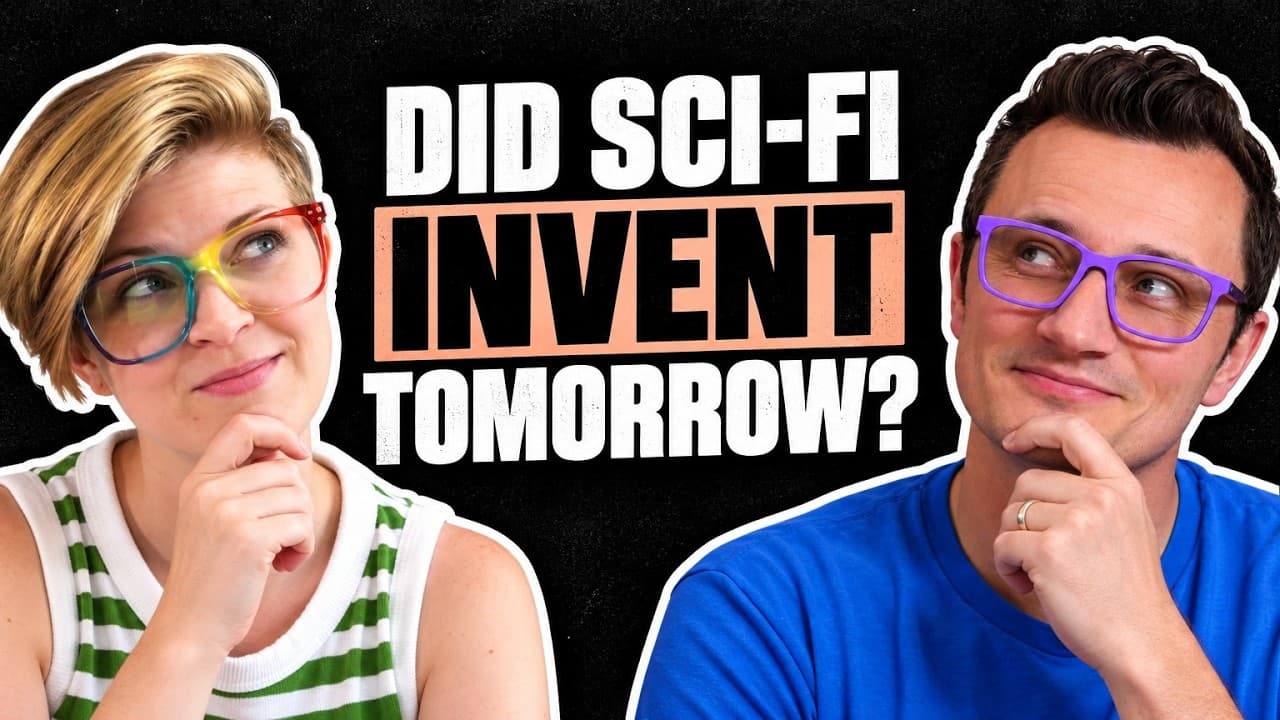
Did science fiction invent our future?
Rob & Caitlin
Watch
THE SAME EPISODE, WITH FACES.AUDIO ABOVE.
Summary
Did science fiction invent our future, or does it just get credit for naming it? Rob and Caitlin dig into the messy relationship between sci-fi and real technology. They start with William Gibson's Neuromancer, which gave us the word "cyberspace" yet still sends its hero to a payphone. From there they follow the Torment Nexus meme to Neal Stephenson's Snow Crash and ask why the real-world metaverse never caught on. Along the way they talk about AI as a philosophical zombie, whether any technology is inevitable, and how 1984 handed us Big Brother as a word for surveillance. They close on the big question: is sci-fi's job to predict the future, inspire it, or prevent it?
Chapters.
- Did sci-fi invent the future, or just name it?
- Neuromancer, cyberspace, and the missing cell phones
- The Torment Nexus and Snow Crash's metaverse
- Why nobody moved into the metaverse
- Rejecting the tech, or the people behind it?
- Was AI inevitable?
- Big Brother and the words sci-fi gives us
- Should sci-fi predict the future, or prevent it?
Key ideas.
- Fiction invents ideas, not technology. Sci-fi writers often get credit because they put an idea into words that lasted and made it memorable.
- No story can predict everything. Neuromancer nailed cyberspace and missed cell phones, because sci-fi pushes one idea to its limit.
- Having the tech isn't the same as wanting it. The metaverse exists and people shrugged. Is that an implementation problem, or are we rejecting the people pushing it?
- AI is "statistically human-ish." Rob uses the philosophical zombie to explain why he doesn't think AI can write fiction the way people do.
- Sci-fi gives us words. Big Brother and cyberspace let us talk about surveillance and the online world.
- Warning, not prophecy. Science fiction can't stop a technology from existing, but it can show us the dangers so we build the guardrails, and maybe don't build the Torment Nexus at all.
Works we discuss.
Also mentioned: Ready Player One, The Matrix, Gattaca, Careless People (memoir), Ray Bradbury
Terms we use.
- Cyberspace: the shared virtual world of computer networks, a word William Gibson popularized in Neuromancer.
- Cyberpunk: "high tech, low life" science fiction about computer networks, body modification, and megacorporations, told from the street level.
- Metaverse: a persistent, shared virtual world where people interact through avatars, named in Snow Crash.
- Torment Nexus: internet shorthand for a tech company proudly building the very thing a sci-fi story warned against.
- Philosophical zombie: a thought experiment about a being that acts exactly like a person but has no inner experience.
- Big Brother: the all-seeing face of the Party in 1984, now shorthand for invasive surveillance.
“The goal of science fiction is to take one thing and push it to a limit that says something interesting about humanity.”
 Rob (04:13)
“We notice the cyberspace and we give him credit for the cyberspace, but where's the cell phones?”
Rob (03:14)

Start here.
The hosts didn't hand out a reading list this time, but the conversation points to two easy doors. If you've read or watched Ready Player One, Rob says Snow Crash is "similar-ish," so it's a natural next step into the metaverse idea. And if you read 1984 in school, as Caitlin points out many people did, you already know where Big Brother comes from. Ready for something denser? Neuromancer is the cyberpunk classic Rob calls "seminal" and "canon."
Transcript.
00:00 Did sci-fi invent the future, or just name it?
- Rob
Welcome to SciFi High Five, the friendliest conversation in all of science fiction.
- Caitlin
We're your hosts, Caitlin Jacobs and Rob Skidmore. And today we're talking about: did science fiction invent the future?
- Rob
So, did science fiction invent the future? Or is it just taking credit for stuff? Yeah, I think so. I would agree.
- Caitlin
Good. Well, we can end the episode there, then. Come back next time.
- Rob
The end. I do think it's interesting, though, this interplay that we have between technology and science fiction. I feel like there's a term for it, can't remember. But it's where different people come up with the same idea even though they're completely removed from each other. I think some of the ideas that science fiction gets credited with are something like that. There are so many people on earth and so many smart people, and I think the reason that science fiction writers get credit is because they're the one that put it into words. Words that lasted.
- Caitlin
And made it popular, because they put it into a story that feels fun instead of just, like, this is something you read about in a tech article.
- Rob
Exactly. And so they make it real, they make it memorable, and because of that they get the credit, and...
- Caitlin
And they name it.
- Rob
They name it, even if it was something that many people had had similar ideas. It's not like science fiction isn't inventing... the only thing that fiction invents is ideas.
- Caitlin
And someone has to take that idea and decide to make it a reality. For better or for worse.
- Rob
Exactly. And there are tons of these ideas in fiction that get turned into reality, and then there's a lot that perhaps never will.
- Caitlin
Yeah, and you kind of get that survivorship bias, where you're remembering the ones that became something real, right? Like the flip phone, right? Like the flip phone. Go ahead.